

Tank Water Issues
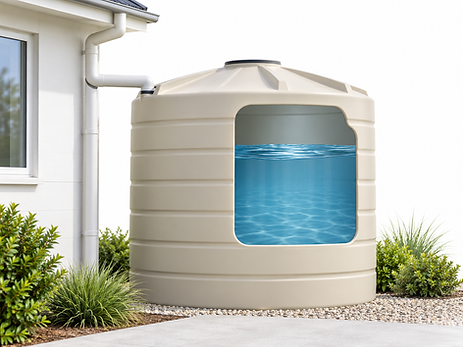
Poly Tanks
There are specific carbon filters designed to remove Volatile Organic Chemicals that may leach into water stored in poly tanks. Most manufacturers state that their tanks are made from “food grade” materials, and this may be the case. However, additives used for UV stabilisation and to assist with the manufacturing process are not necessarily food grade.
Anyone who has placed their head inside a poly tank on a hot day may have noticed the strong odour released from the tank material. This odour comes from volatile polyaromatic compounds, and some of these chemicals may be absorbed into the stored water before being pumped into the household water supply.
Specific carbon filters are available for this particular purpose. As they generally cost no more than other high-quality carbon filters, it makes sense to use a filter designed specifically for water stored in poly tanks.
.png)
Small Tanks
One of the most common issues we encounter with rainwater tank systems is a small tank connected to a large roof area, often as part of compliance with government regulations.
When a relatively small amount of rain falls across a large roof area, it can quickly fill the tank with the sediment, dust and other contaminants that have accumulated on the roof. By the time cleaner rainwater begins flowing from the roof, the tank may already be full, meaning the cleaner water is then diverted to drain.
The lower-quality water collected in these compulsory tanks is commonly used for toilet flushing and clothes washing. However, washing clothes in dirty water is hardly ideal, and using water containing bacteria for toilet flushing can also lead to increased cleaning requirements.
Filtration can improve this water and make it more suitable for washing and toilet use. However, we do not recommend using this type of tank water for drinking. While filtration can make the water bacteria-free, that does not necessarily mean it is free from chemicals or other contaminants.
.png)
Gravity Fed Tanks
The fact that your tank water system does not have a pump does not mean you cannot have an effective water filtration system. There are NSF-approved and certified water filter cartridges available that are designed to remove bacteria and cysts from gravity-fed tank water. This means suitable filtration is still possible even when water pressure is relatively low.
Carbon fibre filter cartridges are also particularly well suited to gravity-fed systems because they create very little delta pressure, or resistance to water flow. Traditional carbon block cartridges can restrict gravity-fed water more significantly, making them less suitable where there is no pump to maintain pressure.
Carbon fibre cartridges overcome much of this issue, allowing effective filtration while maintaining the natural flow of water through the system. As a result, gravity-fed filtration can now do more than simply remove sediment or biological contaminants. With the right combination of cartridges, removing chemical contaminants from gravity-fed tank water is also a practical and viable option.
.png)
Piping
When aiming for high-quality tank water, the materials used to collect and transport that water are just as important as the filtration system itself. Roofing materials, roof coatings, downpipes, pipework and fittings can all affect water quality, so this is not an area where it pays to cut corners.
Older PVC downpipe can contain lead. If you are installing a new rainwater tank, or already have a tank supplied through PVC pipework and fittings, it is important to make sure lead-free PVC products are being used.
The same applies to poly pipe. Rural-grade poly pipe and fittings are designed for rural applications and are not necessarily intended for potable water supply for human consumption. High-pressure poly pipe suitable for potable water applications can generally be identified by blue lines and the WaterMark symbol. If your goal is to achieve the highest possible water quality, it is important to use pipework and fittings that are appropriate for drinking water from the point of collection through to the point of use.
.png)